
Home / Technology Platform
Matrix Binding Technology Platform
A short matrix-binding peptide changes where a drug goes and how long it stays.
Technology platform
Matrix Binding Technology Platform
ProteoThera has developed a tissue matrix binding (MB) protein fusion targeting technology to re-engineer previously validated therapies.
MB platform technology for proteins involves fusion with a proprietary matrix binding sequence based on a 21 amino acid peptide derived from a naturally occurring protein.
The result is site-specific extended retention in the extracellular matrix of charged, proteoglycan-rich tissues — while keeping biologic activity.
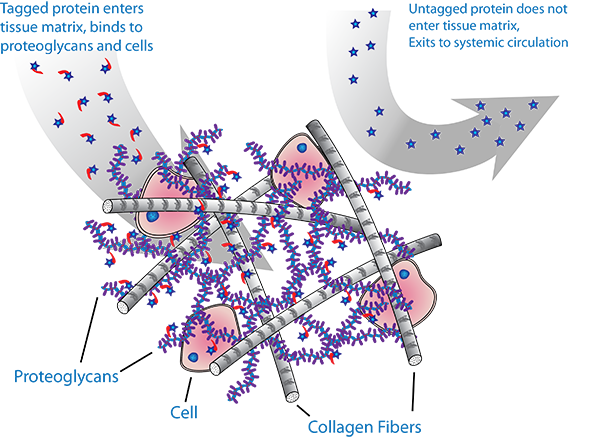
Matrix binding fusion for proteins
MB platform technology for proteins involves fusion with a proprietary matrix binding sequence based on a 21 amino acid peptide derived from a naturally occurring protein.
Site-specific retention
MB targeting enables site-specific extended retention in the extracellular matrix (ECM) of naturally occurring charged proteoglycan-rich tissues, while maintaining biologic activity.
Widely adaptable
The MB technology platform is widely adaptable for use with proteins, peptides or other small molecules. ProteoThera’s proprietary analog of an endogenous heparin-binding domain peptide has been optimized to allow for both extended retention and biologic activity during the therapeutic window.
Creating new pharmacokinetic profiles
The MB technology can generate new pharmacokinetic profiles for therapies, transforming systemically delivered drugs into locally delivered drugs.
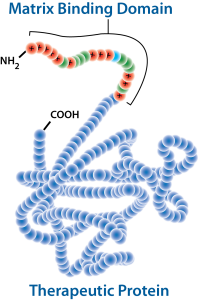
Adaptability
Proteins, peptides, small molecules
ProteoThera’s proprietary analog of an endogenous heparin-binding domain peptide has been optimised to allow both extended retention and biologic activity during the therapeutic window.
That means the same targeting idea can be applied beyond proteins — to peptides and other small molecules.
The evidence behind the platform
At the ACR/ARHP Annual Meeting in 2016, the team presented a matrix-binding IL1RA fusion with IC50 of 152 pM ± 26 pM, against 175 pM ± 23 pM for anakinra — no loss of potency — and retention in cartilage after wash-out.
Pancoast J, Lee RT, Patwari P. ACR/ARHP Annual Meeting 2016, abstract 3076.